Last weekend was the June edition of the 12 Hours of Temecula. A race report is on the way, but here's some background.
The 12 Hour format asks a simple question: How many laps of a short (~1 hr) course can you complete in 12 hours? The competition is broken into solo (aka hardcore or insane) riders and teams of 2, 3, 4, or 5 riders. Mike and I compete in the 2 person open category as Team Sherpa Dog. We usually trade off every other lap, ie, one of us rides a single lap and then the other person goes out. During our off time, Diana cleans up the bike, gets us fed, and makes sure we're back at the transition zone on time for the next exchange.
The 2 person category is both interesting and horrible.
Monday, June 14, 2010


Friday, June 11, 2010
race bike: arrival and setup
The RIP9 has been a good bike for exploring world of xc and enduro races. But it's a lot of bike for most of those courses, and I got interested in having a light, hardtail, 29er. After considering a few options, I settled on the Motobecane Team Fly29er: <24 lbs, titanium frame, Reba Race fork (100mm), and quality components (full specs). It's available as direct order only, which is a little nerve-wracking but an incredible deal.
I swapped a few things:


I swapped a few things:
- Thompson seatpost for OEM Ritchey post (too short)
- 90mm FSA stem for OEM 115mm Ritchey stem
- QR seatpost clamp for stock non-QR clamp
- FSA SL-K bar (660mm wide carbon bar w/ slight rise) for OEM 570mm wide Al Ritchey bar - ridiculously narrow, I think my road bars are wider.
- Stans wheelset (front: 355 Race w/ AC hub, rear: Flow w/ Hadley hub) from OEM Vuelta wheelset
The bike arrived just after we left for a long weekend out of town (a neighbor accepted delivery). Oh, the waiting.... The bike was well packed and arrived in good shape. The welds were neat.
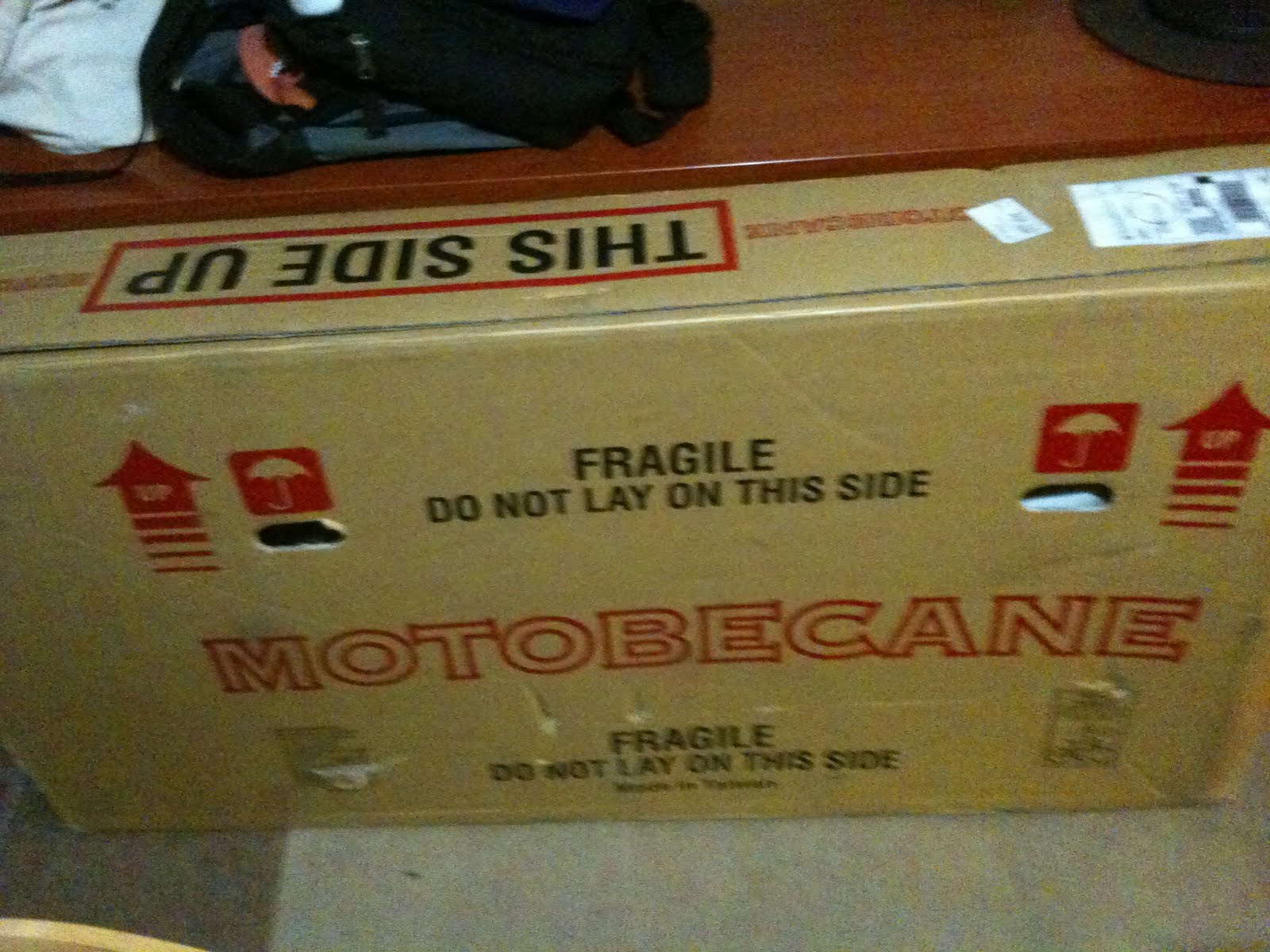
Though well packed and fully assembled, it needed some work. The cranks, BB, and steerer had not been greased. Mike tuned it up:

As equipped (for now):

Wednesday, June 2, 2010
Cancellara vindicated by video analysis
If you watched any of the spring classics this year, you saw incredible performances by Fabian Cancellara, including a few stunning attacks. Apparently there has been speculation that he used some sort of seat post-embedded electric motor.
Were Cancellara's decisive accelerations even humanly possible? How much power did he generate when he hammered the field at Paris-Roubaix?
Physics to the rescue! (Don't get to say that often enough.) The link takes you to an excellent post at Cozy Beehive where video analysis is used to determine Cancellara's speed, acceleration, and power output. There's also a clip of the race in case you missed it. For the sort attention set: the analysis suggests his move required over 1000 Watts during the attack. Humanly possible, but incredible.
Were Cancellara's decisive accelerations even humanly possible? How much power did he generate when he hammered the field at Paris-Roubaix?
Physics to the rescue! (Don't get to say that often enough.) The link takes you to an excellent post at Cozy Beehive where video analysis is used to determine Cancellara's speed, acceleration, and power output. There's also a clip of the race in case you missed it. For the sort attention set: the analysis suggests his move required over 1000 Watts during the attack. Humanly possible, but incredible.
Monday, May 31, 2010
Pump Track Madness
If you can't have a pump track in your own backyard, the next best thing is having friends with one. I'll save pump track physics for another post, but you know something is going on when you can ride around a circular track without pedaling.
Pump Track Madness from Ed Price on Vimeo.
Sunday, May 30, 2010
Log a rythym
Video of the log ride at the Los Gatos / Chico Ravine connector in Laguna. It's very ridable if you hit it with some speed and keep your momentum. Definitely a case where the bigger wheels help - all the bumps seem a little smaller.
Los Gatos Log Ride from Ed Price on Vimeo.
Sorry for the bad math pun.
Los Gatos Log Ride from Ed Price on Vimeo.
Sorry for the bad math pun.
Friday, May 28, 2010
mid-week semi-epic
Blame it on Lit'l Peppers - went for breakfast yesterday and had a generous pastrami croissant. I was already planing to go for a ride, but after stuffing myself I resolved to do something special. Four and half hours, nearly 40 miles, about 4k of climbing; figure that put me in the black for the day.

From my house, I rode to the Claremont side of MTRP, out the Rim to e-ticket, over the Fortuna saddle, up Spring Canyon, over the ridge to Sycamore canyon, over the switchbacks, up and around Martha's Grove, and back the way I came (more or less - took a different side canyon into Spring, and took Suycott Wash and switchbacks climb out of MTRP).
A few highlights:

From my house, I rode to the Claremont side of MTRP, out the Rim to e-ticket, over the Fortuna saddle, up Spring Canyon, over the ridge to Sycamore canyon, over the switchbacks, up and around Martha's Grove, and back the way I came (more or less - took a different side canyon into Spring, and took Suycott Wash and switchbacks climb out of MTRP).
A few highlights:
- The ride started and ended at my house, no driving involved. Except for a couple miles getting to and from the trailhead, it was dirt all the way.
- I haven't ridden the eastern side of Fortuna saddle for years, but the fire roads between the saddle and Mast Blvd were one of the first mtb rides I did in SD, back in 1995. Don't think I got any further up the eastern approach to the saddle than I ever did.
- Wildlife count included 3 roadrunners, 2 snakes (racers? looked like garters but without a dorsal stripe), 2 deer (just before the rock garden in Suycott), and of course lots of lizards.
Thursday, May 27, 2010
MBA article on suspension designs
On more than one occasion I've gotten stuck trying to understand my bike's rear suspension. So I really liked the June 2010 issue of Mountain Bike Action, which has a pair of articles describing the challenges in rear suspension design and analyzing the most commonly used designs. I'm not usually a fan of MBA (aka Wankers Weekly, as Josh calls it)... too many press releases thinly disguised as 'reviews'. But this is an in-depth and informative article that helps explain current rear suspension designs.
I can't find the article on their website, so here's an excerpt. I can send you the whole article if you email me. The full article discusses 4-bar links, single pivot, and designs used by Trek, Specialized, Santa Cruz, Felt, GT, Haro, Ellsworth. The color figures are much better than b&w, too.

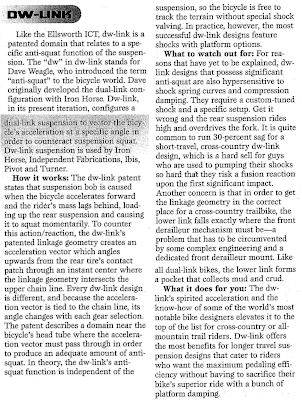

I can't find the article on their website, so here's an excerpt. I can send you the whole article if you email me. The full article discusses 4-bar links, single pivot, and designs used by Trek, Specialized, Santa Cruz, Felt, GT, Haro, Ellsworth. The color figures are much better than b&w, too.


Subscribe to:
Posts (Atom)